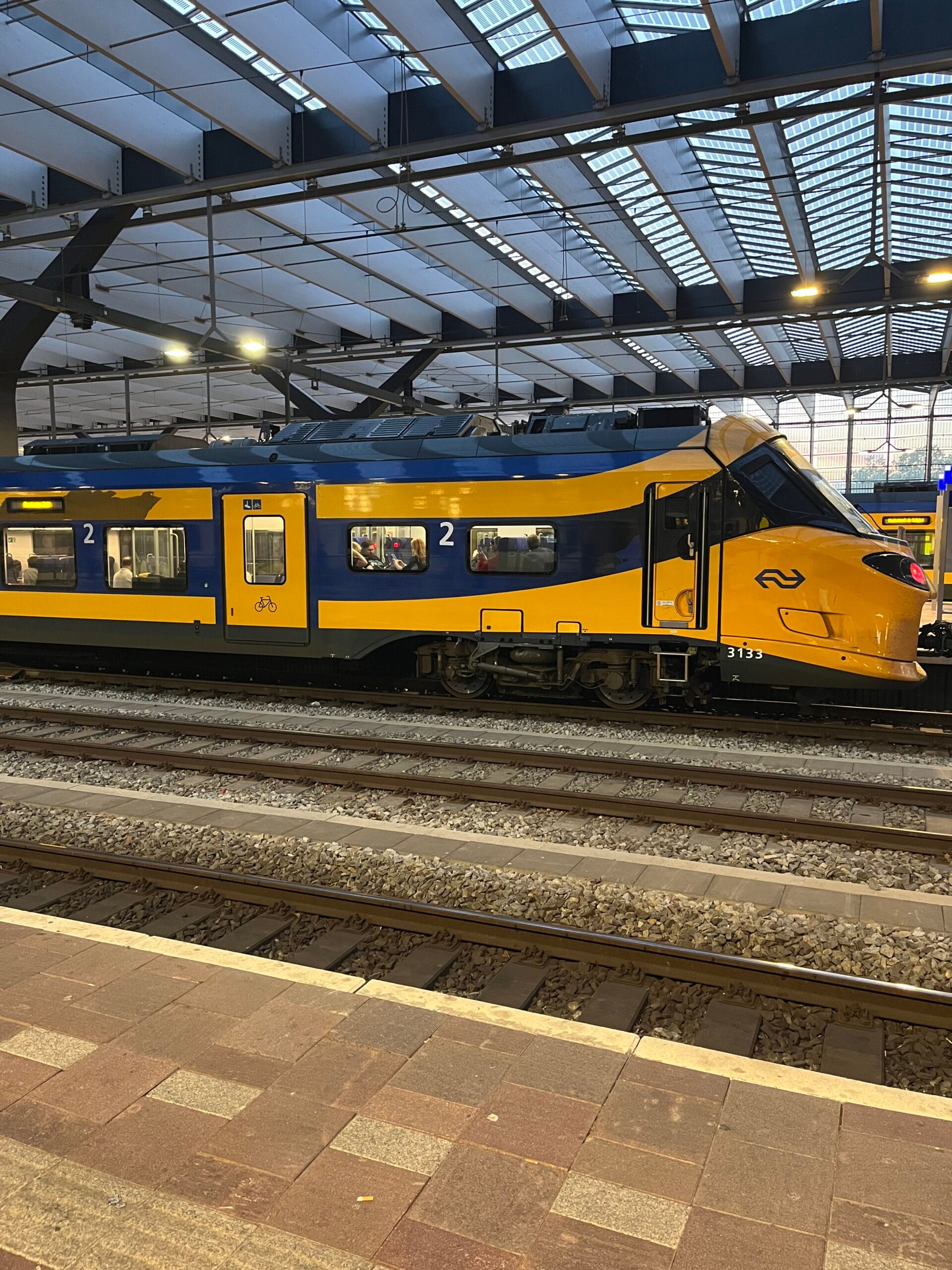
The Netherlands has some of the best public transport in Europe. Their train network coverage is extensive, ensuring the entire country is accessible. Within cities, the bus and trams take you everywhere you need to go. The transport options are frequent, well-connected, on-time, and very clean (way better than what you see in the US or even in neighboring countries like Belgium and Germany).
Zero need for a car. Coverge decreases in rural areas, but most tourist attractions are not there.
Delays are usually small, cancellations infrequent. Be careful of strikes though
You won’t be worried about catching something from where you sit, but rude people who leave trash do exist
Drivers are very observant and will kick-off anyone who causes disturbance
Plenty of space for you and your stuff. Crowded in peak hours though and hot in summer (often no AC)
Quite Expensive
Of course, the biggest transport flex of all is the Dutchies widespread bike use. You might’ve heard the age-old adage that there are more bikes than people in this country and I can assure you, it’s true. People often have multiple bikes, sometimes using one to bike to the train station while a second bike is waiting for them when they get off in the next city! To not experience biking in this country would be a shame.
So, you can easily hit any spot on your Netherlands bucket list without a car, although the downside to this high level of service is the price. To learn more about the Dutch public transport system and how to use it, click on the categories below or…
Most Important Things To Know
- Bikes rule, and they are everywhere. Red paths are for bikes, so stay off of those when walking. Sometimes bikes will also share the road or sidewalk with you, but they won’t stop for you (even if you have a crosswalk, a lot bikers don’t respect that!)
- You can never pay with cash.
- Both check-in AND check-out are required. You do this by scanning your payment method/ticket at the gates or on the little payment boxes on the vehicle. This ensures you get charged the right fare.
- To get off the bus and tram, you need to press the stop button.
- Some common courtesies and rules for riding:
- Don’t take phone calls on speaker or watch videos out loud.
- Respect silent carriages on trains (or someone WILL tell you to be quiet).
- Take trash with you or throw it away onboard.
- Do not put feet on the seats (shouldn’t need to mention this, but my own sister got yelled at for feet on the seats… no one wants to sit in the shit your shoes have been in.)
Modes and Usage
Bike
If you’re visiting the Netherlands, chances are you’ve already heard it’s a bike Utopia. Holland is completely connected by bike network, including having special bike highways! You feel very safe on a bike here for a few reasons: 1) car drivers are trained to be hyper aware of bikes 2) the biker is never at fault which gives riders a lot of reassurance (sometimes too much) and 3) bikes and cars typically have a pysical barrier between them.
Biking in Holland isn’t just transport, it’s an experience. Picture yourself cycling along the canals, wind in your hair, wondering how this place can be real. And if you need entertainment, just watch what the Dutch are carrying on their bikes. A Christmas tree? A mattress? I’ve seen both. At the very least, you’ll spot someone casually carrying a friend or two on the back.
To rent a bike yourself, just google bike rentals in the city you’re visiting.
Train
The Dutch rail network is one of the most extensive and efficient in Europe, making it easy to travel between cities without a car. Most major destinations are connected by frequent services, and even smaller towns typically have a train station nearby. For many journeys, the train is the fastest and most convenient way to get around the country.
Bus
Buses fill the gaps between train stations and smaller towns, villages, and residential areas. In urban areas, buses run frequently throughout the day (think every 10 minutes) and in rural areas they run slightly less frequently (think every 30 minutes). Still, they are heavily used throughout the country
Tram/metro
Trams and metros are used for intra-city transport, usually reaching to the outskirts of the city. Trams are common in cities such as Amsterdam, The Hague, Delft, and Rotterdam, whereas only Amsterdam and Rotterdam also operate metro systems.
Scooters, Mopeds, and Shared Bikes
Shared mopeds are available in the Netherlands, but the step or kick scooters are banned on all roadways, so you won’t find shared options for these. The mopeds are can be picked up and left all over most large cities through a platform called “Check”, but I wouldn’t say you see them EVERYWHERE. So, a decent option to consider but not to fully rely on.
Booking and Payment
The easiest way to buy tickets, and one of the things that makes public transport in Holland so accessible is to “check-in” via payment boxes. For train and metro, these are located at the station gates and for buses and trams they are directly inside the vehicle. You don’t even need tickets, you just scan in (tap your card) when you get on and scan again (with the SAME card) when you get off. The fare is calculated automatically.
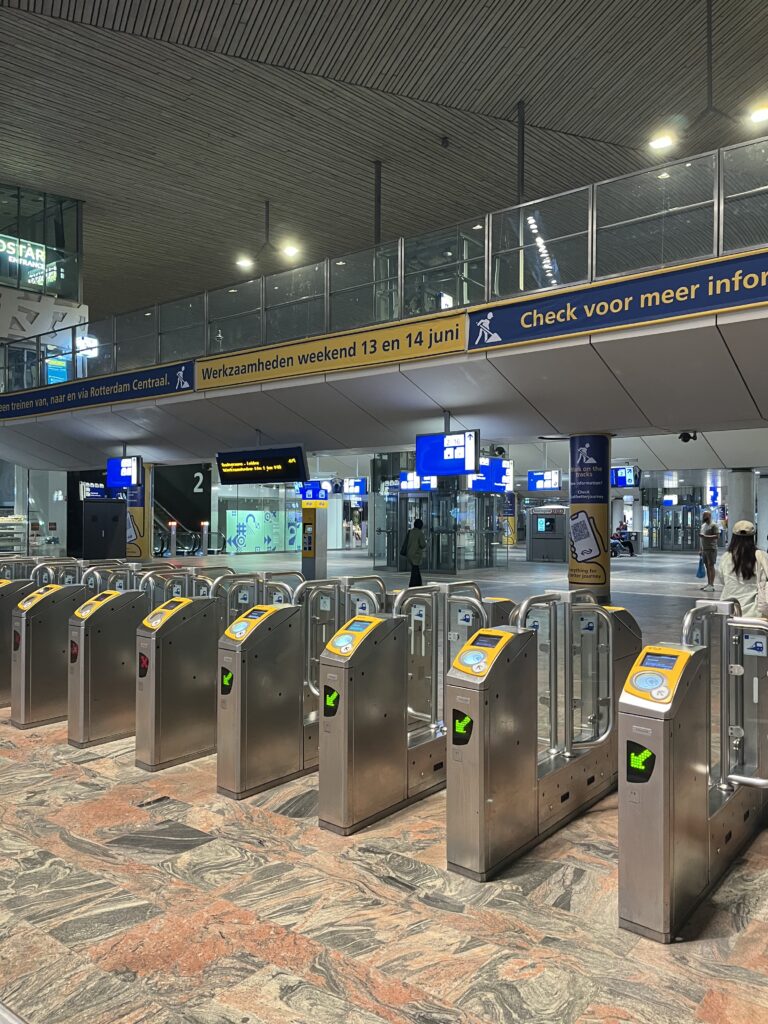
Check-in gates at the train station
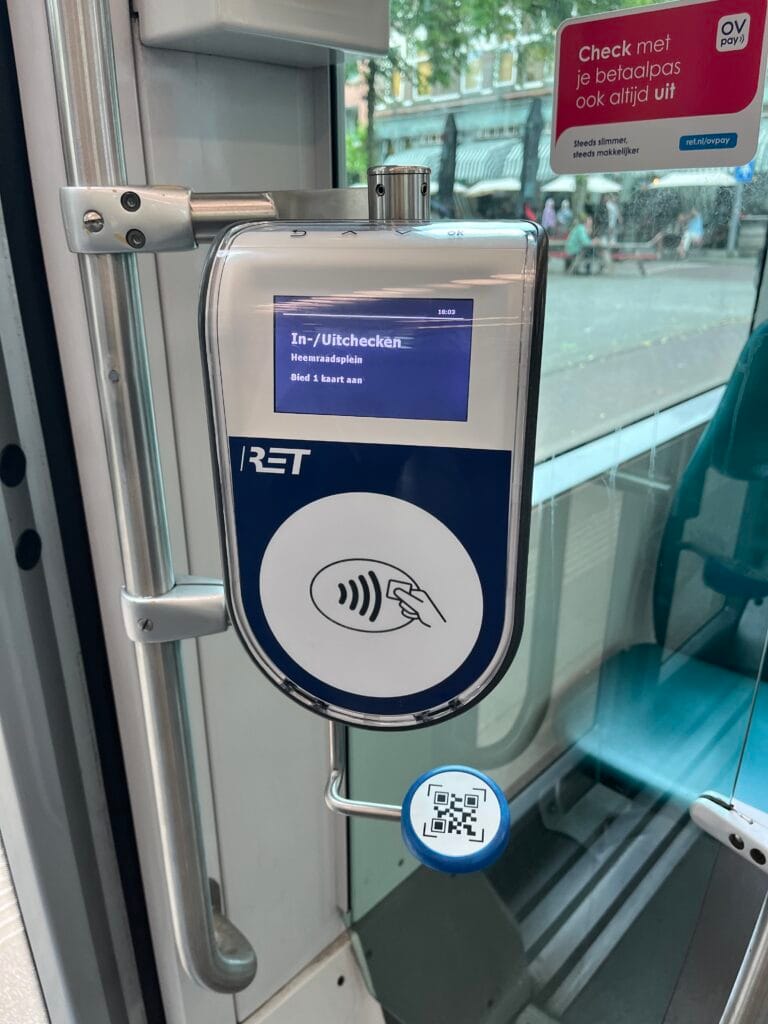
Check-in terminal on the vehicle (tram & bus)
These scanner machines take credit card, debit card, and prepaid cards. If the ticket checker comes around and you’ve used this scan-in-out method, you just let them scan the credit/debit card you used and you’re good to go!
The prepaid card in the Netherlands is called the “anonymous OV chipcard.” You can buy it at ticket machines inside train stations, although it’s completely unnecessary because it doesn’t save you any money. You also don’t save any money by buying tickets beforehand, so there’s really no reason to reserve online or in the station.
If you don’t use the check-in/check-out direct payment, here are your other ticket buying options:
Ticket Machines
Located: inside train and metro stations. Occasionally can be found inside a tram, but I wouldn’t rely on this
Payment options: credit card, debit card, apple pay
Options: You can buy single journey tickets, day or multi-day tickets, buy a prepaid travel card, or refill a prepaid card
Online
For trains, you can buy tickets directly from the train operator (NS) or from a third party booking software, Omio. Using Omio could be nice if you are doing a far or multi-country journey, so you don’t have to download so many apps. Sometimes, they also have deals going as well. International train tickets (like to Germany or Belgium) can also be booked from the Dutch train operator’s international website.
You cannot buy tram or bus tickets online.
You can NEVER pay with cash and you cannot buy a ticket from the driver. They will only do this if something isn’t working for you
How far in advance do you need to book?
You don’t need to book in advance at all. You can literally walk up, scan your credit card, and get on a train.
The busiest times are called “peak hours” and are on weekdays from 6:30am-9am and 4-6:30pm
For international train tickets, you do want to book in advance for better prices and to ensure availability in the summer. I’d say at least 2 weeks in advance to be safe, but it’s possible to book right up to departure.
Cost and Discount Cards
Dutch public transport costs quite a bit, think a few euros for rides within the city and in the teens to 20s for rides to other cities.
Are there discount cards for tourists? Only in certain cities (Amsterdam, Rotterdam) plus a nationwide day pass (rarely worth it).
As a tourist, you can get an anonymous OV-chipcard, which is a pre-paid travel card that you load money onto, but these do not save you anything. They are simply for convenience if you don’t want to pull out your credit or debit card or if you have international transaction fees.
Below are the discount card options for Amsterdam, Rotterdam, and nationwide:
iAmsterdam
Includes: access to 70 museums and attractions, a canal cruise, a bike rental, local public transport use (basically everything but the train), and discounts at some restaurants
Cost: €67 (1 day) – €140 (5 days). Cost per day decreases with number of days selected.
The iAmsterdam card is a cool and handy pass that’s especially useful if you are staying multiple days. However, it is not worth it for transport alone. You need to visit a couple museums and take advantage of that free canal cruise too. Then it’s worth it!
Buy here
Holland Travel Ticket (1 day)
Includes: unlimited travel on trains, bus, tram, metro, and ferries. Does NOT include discounts on museums or attractions
Cost: €54 (off-peak hours and weekends) or €79 (anytime)
In order for this to be worth it, you would need to shove A LOT of travel into one day. You’d probably need to do a round trip to a city 2-3 hours away, plus intercity travel at your destination. so, I’d check the cost of your intended route before buying this.
Buy here
Rotterdam City Card
Includes: local public transport (no train) and 25% discount to 50+ attractions
Cost: €17.50 – €32.50
The low cost for the Rotterdam city card makes it immediately worth it. After a few public transport rides and a discounted attraction entrance, you’ve probably already got you money’s worth.
Buy here.
Tourist day ticket (South Holland – Rotterdam, the Hague, Delft)
Includes: local public transport (no train)
Cost: €17.50 – €32.50
Very similar to the Rotterdam City card, the tourist day ticket includes public transport in other cities in South Holland such as The Hague, Delft, and Leiden. It doesn’t include train transport though, so you’ll mostly have to pay to get between these cities. If you are doing day trips to more than just Rotterdam, then this could be worth it, but with no attraction entrance included, you would need to do more than just walking around the city center to make this travel ticket a good option.
Buy here.
Eurail or Interail passes
Includes: unlimited train travel for a certain number of days, within a longer timespan
Cost: $150-$255
Eurail and interrail passes are rail passes that allow unlimited train travel across 33 countries in Europe. I absolutely LOVE these, especially if you are doing a multi-country trip. You can read more about them in my article how to spend less on transportation, but they work in the Netherlands. In order to be worth it, you need to have at least 3 “big” train travel days or be visiting more than just 1 or 2 cities.
For Netherlands travel, you can choose a global pass (valid in all 33 countries) or Benelux pass (valid in Netherlands, Belgium, Luxembourg)
Buy here.
Ticket Checks
Ticket checkers come around pretty frequently (less so during late hours but still). They will wear branded clothing from the operator (ex. NS, HTM, GVB, etc.), so don’t trust anyone in plain clothing.
The fine is 70 euros plus the price of your fare, so it’s really not worth trying to scam the system.
In busses, there is no ticket checker, but you will enter and be required to scan at the front of the bus, directly in front of the driver. They will stop you if you don’t check-in.
Route Planning
Honestly, Google Maps is great for route planning in the Netherlands and even stays pretty up to date on delays. Still, I’ve been taught a lesson or two from relying on it too closely.
The best, most up to date option is NS travel planner. Although NS is the train operator, they integrate all modes into their planner. They also give the most detailed info, including platforms and which side of the train to exit.
Stop information is digitally displayed on screens in all the modes of transport!
Seat Reservations
You do not need seat reservations on trains in the Netherlands (in fact, it is not even possible)
For international trains, you can book seats. I would say this is only necessary during peak season (summer).
Luggage, Stollers, Bikes
Luggage
Traveling with luggage on public transport in the Netherlands is quite easy. Trains to/from the airport usually have dedicated places for your luggage. Even without dedicated spaces, you can sit in a 4-person seat with luggage in between your legs/next to you, you can slide them between the backs of two seats (see image), or you can stand by the doors with your suitcases.
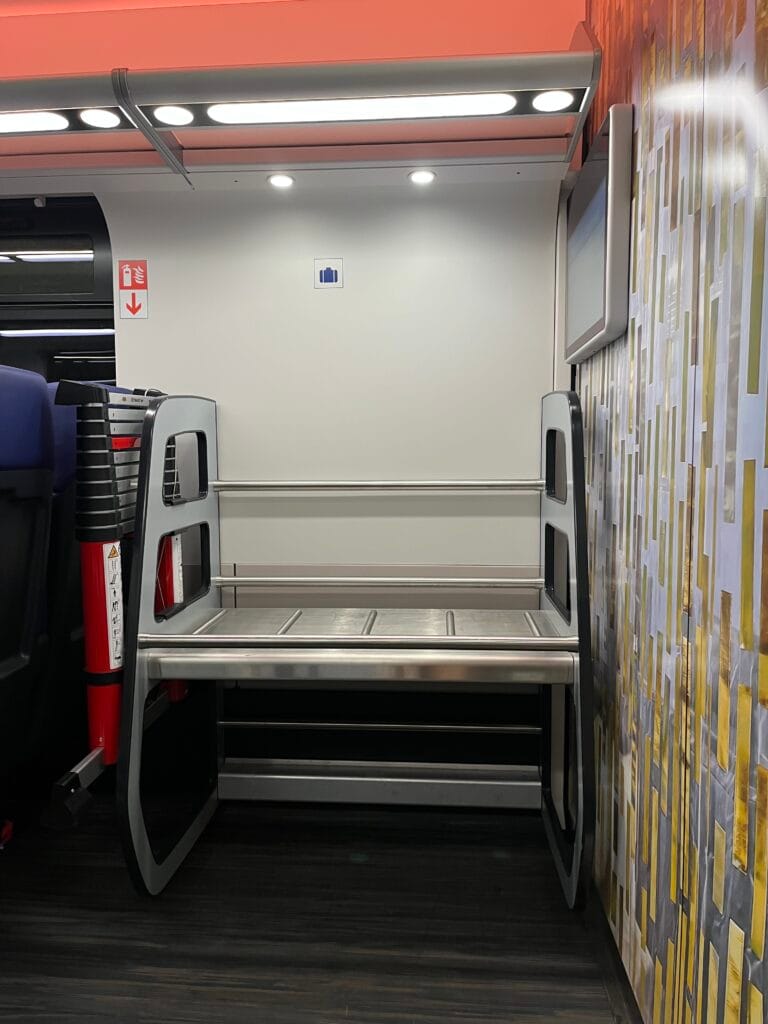
Overhead and designated luggage storage
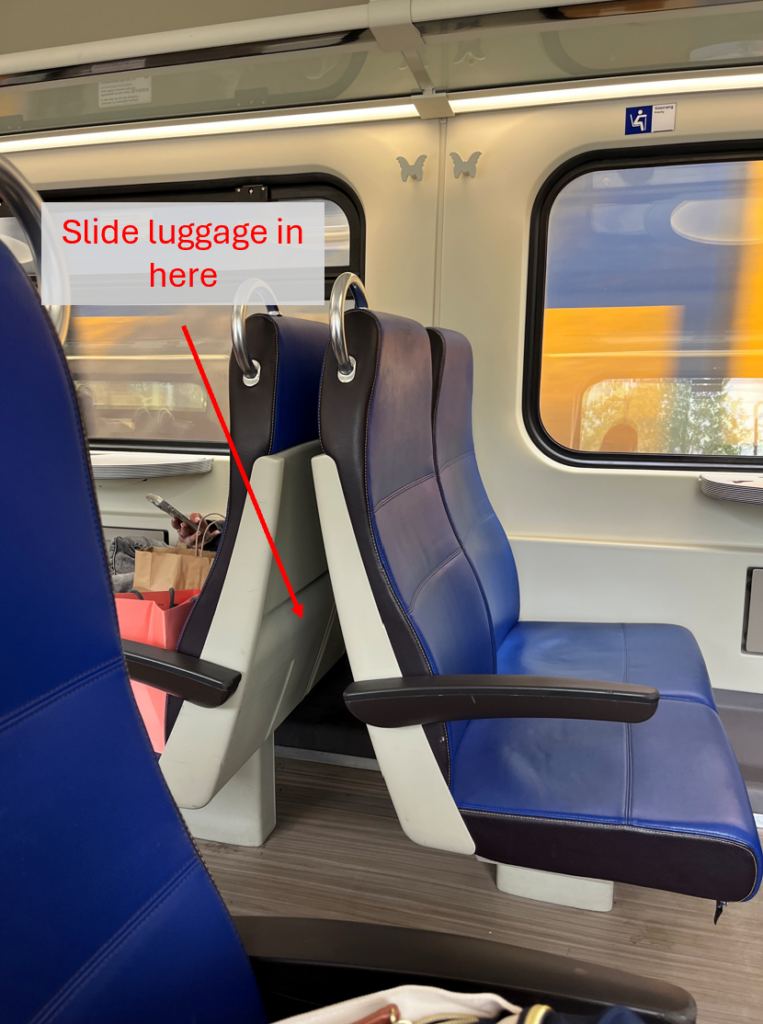
Store luggage between seats (bigger than it seams!)
On buses, trams, and metros, there is also room to wait by the doors, and this is where people with luggage usually go. Sometimes there i a dedicated bike and stoller area. In any mode, you can always just put it next to you if it’s not too busy.
Strollers
As mentioned for bikes, there is often a dedicated stroller and bike standing area in buses and trams that you can use. On trains you can stand or sit by the doors, as usually there are some seats there for this purpose.
Bikes
You can transport your bike on Dutch trains, but only during certain times of day. You can bring your bike during weekends and on weekdays during off-peak hours (from 9.00 a.m. to 4.00 pm. and from 6.30 pm. to 6.30 am).
For the train, you need to buy a ticket for your bike (€7.50). NS trains sometimes have designated bike carriages, which you can find by looking for the bicycle on the side of the train. If your train doesn’t have that carriage, you can just hold your bike in the waiting or seating area near the doors.
The same time rules apply for the metro, except taking your bike is free. There are no bike-specific carriages.
You are NOT allowed to bring a bike onto most buses and trams in the Netherlands, except folding bikes. There are a few exceptions, such as some trams in the Hague and Delft.
Storage lockers at stations
There are luggage lockers at most train stations in the Netherlands. You can book these by walk-up only, for up to 72 hours.
Learn more.
Safety, Cleanliness, and Comfort
Safety
The public transport in the Netherlands is pretty safe. You won’t see homeless camping out on the transport, and people are generally respectful. The drivers are also very observant and will kick off anyone who causes a disturbance. Your biggest concern is probably a group of drunk tourists or teenagers acting dumb or being rude.
Cleanliness
Public transport in Holland if pretty clean. In my opinion, one of the cleanest in Europe. It’s not perfect, but I think you’d probably have to travel to Asia to get better (or maybe just Austria, they are pretty clean too!) There are trashcans on every transport mode, and the vehicles are cleaned frequently. You’re unlikely to find gunk all over the seats or pee in the corner, and unlike most some public transport I’ve ridden in the U.S., you won’t be afraid of catching a rash from sitting down.
That being said, some rude people do leave trash. The outsides of the trains can also be dirty or vandalized, which might block your view a little
Amenities (Wifi, Bathrooms, Etc.)
Pretty much every train has a bathroom (called WC). They are free.
Most trains also have free Wi-Fi, but I wouldn’t rely on the connection.
NS trains do NOT have food on board, but every station will have a place for you to grab a bite.
Buses, trains, and trams do not have bathrooms, Wi-Fi, or food.
Fun Facts
- Cycling culture was given a foundation in the Netherlands in the 1920s after Dutch Royals, Queen Wilhelmina and Princess Juliana were photographed riding bicycles. The royal biking tradition persisted through changes of the crown and still remains with today’s Kind and Queen. Around this same time in the USA, Cars were being established as part of the “American Dream” and as a status symbol because of prominent families like the Rockefellers parading in their vehicles. Both are examples of status influencing transportation, but in opposite directions!
- The Dutch Royals’ love of bikes earned them the nickname “bicycle monarchy”.
- Although bikes were extremely popular, Amsterdam was still a car city in the 1970s. It only became a bike city after huge protests ensued due to a rise in road fatalities, especially child fatalities. At first, cars were banned on Sundays, but eventually Urban planning was redesigned to accomodate people on two wheels.
- Although Dutch public transport is an integral part of life and considered a poster of success in the transport world, it is still heavily subsidized by the government. This is further proof that good public transport doesn’t = profit. It’s about delivering a service to the people that serves a greater good.
- The oldest tram in the Netherlands, line 1, runs from Delft, through the Hague, and ends at Scheveningen beach.
- The previous Prime Minister of The Netherlans biked to work everyday
- All the trains are electric and powered by 100% renewable wind energy! The Netherlands was the first country to achieve this
- Some buses run on hydrotreated vegetable oil (basically used frying oil), which has 1/10 of the emissions of Diesel!
Did I miss something? Ask your questions below!
TLDR · Summary
Public Transport in the Netherlands
Tickets & Planning
International tickets
Compare modes
Planning